


Brushless Blower
Your Professional Brushless Blower Supplier
WinCend Technology (Shenzhen) Co., Ltd. was established in 2014 and is located in thegang District of Shenzhen, a high-tech hub. It is an integrated enterprise that combines research and development, production, sales, and service. High pressure blower; large flow blower; brushless speed control blower; DC inverter blower; custom blower; integrated motor we will develop with you with more diversified products and better services, look forward to cooperating with you sincerely!


Why Choose Us
Our Certificate
Our Obtain more than 40 patents and soft technology; national high-tech enterprise; CE certified products; ISO9001 national quality system certification.
Production Market
Our products are mainly sold to domestic enterprises and more than ten countries in Europe, America and Southeast Asia.
Our Service
We Comprehensive pre-sales consultation, technical guidance, after-sales support, and long-term maintenance services.
Strong R&D Capability
We More than 40 patents and software copyrights supported by continuous technological innovation.
Types of Brushless Blower
Helical Screw Blowers
Each helical screw blower has a main rotor with two lobes. This rotor fits into the flute of a second rotor. The two rotors turn in a helical pattern that is carefully timed so they do not contact each other.
Centrifugal Blowers
Centrifugal blowers are the most common blowers used in ventilation systems. They’re also used to transport gas and control air pollution. When an air stream passes through this blower’s rotating impellers, it increases in both speed and volume. Centrifugal blowers actually change the airflow’s direction as well.
High Speed Blowers
If you need a blower with a significantly high pressure and flow, look for a high speed blower. These electrical blowers run via a motor. They have impellers at each side of the shaft to provide double suction. High speed blowers can reach a pressure up to 25 psi and a flow up to 15,000 m3 per hour.
Regenerative Blowers
Regenerative blowers create pressure by displacing air molecules. The impeller spins to draw in and then capture the air between every blade. As the impeller continues to spin, it pushes the air forward, where it goes back to the bottom of the blade.
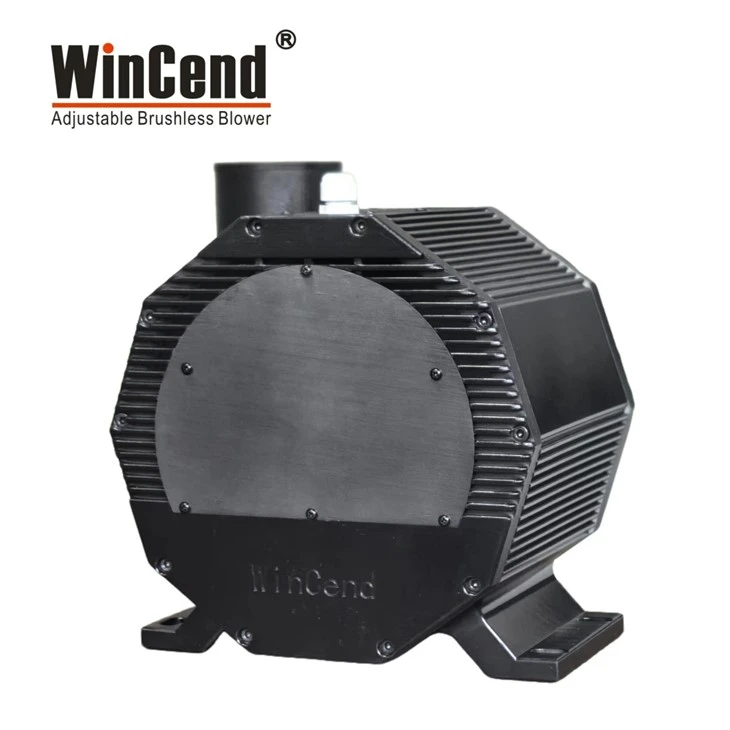
Efficiency and Energy Savings
Energy efficiency is one of the most important metrics in fan technology. A traditional AC fan can provide stable airflow, but its speed control options are limited—it usually runs at a fixed rate determined by the AC frequency.
Noise and Vibration Performance
Noise reduction is another major advantage of brushless technology. Because there is no mechanical friction between brushes and the commutator, brushless blower fans operate more quietly and with less vibration. This makes them ideal for environments where silence and stability are important—such as laboratory instruments, home appliances, or high-end computer systems.
Long-Term Value and ROI
While brushless blowers may have a higher initial cost compared to brushed or AC fans, the total cost of ownership is lower over time.
Design Flexibility and Control
Another strong reason to choose brushless technology lies in its adaptability. With intelligent speed control via PWM or temperature sensors, brushless blowers can automatically adjust their airflow based on the environment.
Basic Structure Of Brushless Blower
Motor part
The core of a Brushless Blower is its motor, usually a brushless DC motor (BLDC). Compared with traditional brushed motors, brushless motors have no carbon brushes, which reduces friction and wear, thereby improving efficiency and lifespan.
Fan blades
Fan blades are an important part of the blower and directly affect the performance of air volume and air pressure. The design of the blades usually uses aerodynamic principles to optimize their shape and angle to improve the efficiency of airflow.
Control circuit
The control circuit is the "brain" of the brushless DC blower and is responsible for regulating the operating status of the motor. It usually includes drive circuits, sensors and control units.
Shell
The casing not only protects the internal components, but also affects the blower's cooling performance and noise level. The shell material is generally plastic or metal, and factors such as heat dissipation, strength, and aesthetics need to be taken into consideration during design.
Brushless DC motors use permanent magnets as the rotor, eliminating the need for commutators and brushes. The rotor is rotated by detecting the position of the rotor's magnetic poles and switching the coil through which current flows. Therefore, brushless motors require a drive circuit (driver).
By converting it into an electrical signal, the position of the permanent magnet (N or S pole) is detected, and the motor shaft is rotated by switching the coil in which the current flows.

Application of Brushless Blower
Electronics Cooling
Servers, PCs, gaming consoles, and telecom systems.
Medical Equipment
MRI cooling, ventilators, and patient monitoring systems.
Home Appliances
Air purifiers, dryers, and vacuum cleaners.
Industrial Equipment
Automation systems, battery management, and inverter cooling.