


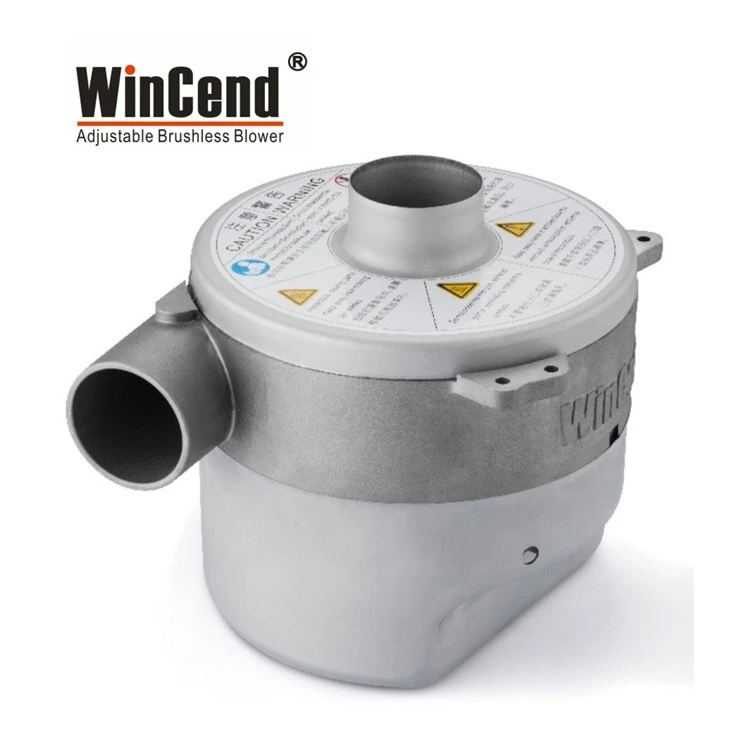


Brushless Fan
If you are still relying on traditional AC or DC fans that use carbon-brush commutation, you have probably run into a few familiar problems. Carbon dust from brush wear can contaminate your cleanroom. Stopping the line to replace brushes interrupts your production schedule. The fan runs at full power the moment it is switched on, driving up your electricity bill. And when you need to fine-tune the airflow, a traditional fan simply cannot keep up.
WinCend Technology (Shen Zhen) Co., Ltd specializes in the research, development, and manufacture of brushless blowers, bringing brushless DC technology into the industrial fan market. This is far more than a simple change of power source - it is a fundamental shift from mechanical commutation to electronic intelligence. Below, we walk you through exactly what this blower can do for your equipment.

What Is A Brushless Fan?
A brushless fan (BLDC fan) is built around a permanent-magnet brushless motor with electronic commutation. It eliminates the carbon brushes and mechanical commutator found in traditional brushed fans, and instead relies on a drive controller with Hall-sensor or sensorless control algorithms to spin the rotor. The result is a new generation of energy-efficient, long-life equipment for air delivery, cooling, and pressure boosting - available as axial fans, centrifugal fans, blowers, and ducted high-flow fans.
WinCend brushless speed-regulating blowers need no external variable-frequency drive. Using an analog signal (0–5V / 0–10V) or PWM, you can achieve stepless speed control across the full 0–100% range. This lets you adjust pressure and airflow in real time to suit each stage of your process - a strong blast for dust removal, gentle suction for pick-and-place, or a steady pulsing flow for mixing. A single fan can cover multiple process needs, greatly simplifying your air-path design and cutting peripheral control costs.
Electronics workshops demand the highest levels of cleanliness and safety. Because WinCend fans use advanced brushless motor technology, there is no brush friction during operation - no sparks and no dust are generated, eliminating hazards at the source and keeping your cleanroom uncontaminated. The motor drive circuit and the air chamber are isolated from each other, effectively keeping out dust, moisture, and corrosive gases for stable, reliable long-term operation.
Key components are fitted with imported high-precision bearings, and an optimized cooling air path gives the whole unit a design life of more than 20,000 hours. Day-to-day operation is maintenance-free, greatly reducing equipment downtime. Brushless motors are also inherently efficient, run cool, and draw less power, delivering significant energy savings over traditional brushed fans and helping you keep operating costs down year after year.
The compact body takes up little of your equipment's valuable space. With support for horizontal, vertical, and other mounting orientations, the fan integrates easily into pick-and-place machines, cleaning systems, automated test equipment, and all kinds of custom-built machinery.
Six Upgraded Core Features
Imported original bearings - deliver smooth, quiet running and extend the service life of the fan.
High-performance IGBT drive circuit - provides more stable drive and faster response, boosting working efficiency.
Non-standard customization - we tailor the fan to your specific operating conditions for the best-fit solution.
High-precision dynamic balancing - every fan is carefully calibrated before shipment, ensuring lower vibration and less noise.
Comprehensive protection circuit - multiple safeguards including over-current, overload, and over-temperature protection keep your equipment safe.
Bypass structure for cooling and operation - an airflow bypass design handles cooling and working duties at the same time, making your fan more efficient.
Technical Specifications
|
Parameter |
Specification |
|
Input Power Supply Voltage |
AC100–120V / AC200–240V / AC380V 50–60Hz / DC24–400V (customizable) |
|
Maximum Power |
600W 丨 1200W |
|
Maximum Vacuum |
-82 mBar (-8.2 Kpa) 丨 -120 mBar (-12 Kpa) |
|
Maximum Pressure |
85 mBar (8.5 Kpa) 丨 124 mBar (12.4 Kpa) |
|
Maximum Air Volume |
250 m³/h 丨 300 m³/h |
|
Maximum Speed |
14000 r/min 丨 20000 r/min |
|
Speed Control |
0–10 VDC (options: 0–5 VDC, PWM, 4–20mA, built-in potentiometer) |
|
Outer Diameter |
148 mm |
|
Interface Diameter |
32 mm / 44.5 mm |
|
Weight |
1.9 KG |
How Do Brushless Fans Serve the Agricultural Sector?
1. Greenhouse cultivation (the most widespread use)
Ventilation and air exchange: swaps indoor and outdoor air to regulate temperature, humidity, and CO₂ concentration, expels harmful gases, and supplies the carbon dioxide crops need for photosynthesis.
Air circulation: internal circulation fans remove temperature and humidity dead spots, prevent localized condensation, and reduce diseases such as downy mildew and powdery mildew.
Cooling and dehumidification: in hot weather, fans work with wet pads to form a pad-and-fan cooling system that quickly lowers the temperature inside the greenhouse; in humid weather, forced exhaust removes moisture.
Assisted pollination: airflow gently shakes plants during flowering to spread pollen, improving fruit set in vegetables and fruits.
Frost and condensation prevention: nighttime airflow prevents frost from forming near the ground and stops dew from settling on leaves.
2. Grain storage and post-harvest handling
Ventilation and drying: mechanical ventilation in granaries and grain piles disperses surface moisture, lowers moisture content, and prevents heating, mold, and pests.
Cooling and pest control: low-temperature ventilation keeps grain cool, suppressing insect eggs and mold growth and extending storage life.
Air cleaning and grading: after threshing and drying, airflow blows away straw, shriveled grains, and dust for air-based sorting.
Grain drying: paired with heating equipment, the fans deliver hot air to dry rice, corn, wheat, and more.
3. Livestock and poultry farming
Exhaust and ventilation: removes ammonia, hydrogen sulfide, dust, and moisture, improving the air inside the house and reducing respiratory disease.
Summer cooling: negative-pressure fans combined with wet pads provide forced cooling, preventing heat stress and protecting feed intake and growth.
Winter ventilation with heat retention: low-speed ventilation expels stale air without a significant drop in temperature, resolving the conflict between keeping warm and ventilating.
Dust and odor removal: reduces dust and odor in the house for a better farming environment.
4. Fruit, vegetable, and edible-fungi cultivation
Mushroom growing rooms: continuous ventilation supplies oxygen and expels CO₂ to support fungal growth and prevent deformed or spoiled mushrooms.
Ripening and cold-storage rooms: circulation fans keep temperature and humidity even, preventing localized frost damage and water loss; air exchange adjusts gas composition to extend shelf life.
5. Field and plant-protection work
Air-assisted spraying: air-blast sprayers use the fan to create a directed airflow that carries droplets into the crop canopy and onto the underside of leaves, improving pesticide adhesion, reducing chemical use, and minimizing drift.
Frost protection: before a frost, large circulation fans stir the air to break up cold-air layers and protect crops from freeze damage.
Straw and forage handling: fans work with other equipment to convey and spread forage, speeding up natural drying.
6. Aquaculture
Aeration: working with aeration pipelines and paddle-wheel aerators, fans deliver air into the water, raising dissolved oxygen levels and preventing fish and shrimp from gasping at the surface or dying off.
Water circulation: keeps water moving, improves quality, and reduces the buildup of harmful substances.
In summary, in agriculture, fans serve a few key roles - ventilation and temperature control, dehumidification and disease prevention, air cleaning and drying, air-assisted spraying, water aeration, and grain storage. They are essential supporting equipment for stable yields, reduced losses, and disease control.
Beyond agriculture, WinCend brushless fans are widely used in electronics manufacturing, material-conveying equipment, smoke and dust purification, condensation systems, atmospheric sampling, fuel cells, sports equipment, and medical devices.
Whatever Customization You Need, We Can Deliver
As the original manufacturer, we supply you directly - no middleman markup.
When a standard model does not fit your equipment, we offer build-to-order customization:

● Parameters - choose the airflow, pressure, speed, voltage and frequency, and power you need.
● Structure - we adjust overall dimensions, inlet and outlet angles, mounting method, and interface specifications to your requirements.
● Special functions - high-temperature resistance, low noise, anti-corrosion, dust-proof, or explosion-proof designs are all available.
Every custom fan goes through rigorous performance testing, burn-in testing, and precision calibration before delivery, so you receive a product you can rely on.
Safety and Usage Notes
Please read these safety instructions carefully before use.
Important: keep hands and objects away from the inlet before powering on, to prevent injury or damage caused by suction.
Do not disassemble the blower - doing so may cause electric shock or injury. Never touch any rotating part while the motor is running.
Make sure the blower's rated voltage matches your power supply. A 110V unit must not be connected directly to a 220V circuit, as this may cause fire or equipment failure.
Connect the grounding terminal to a class-3 ground (below 100 ohms). Poor grounding may cause electric shock or fire. Never change wiring while the power is on. Do not connect a 220V supply to the signal input terminals, and always observe the correct DC polarity - incorrect connections may cause injury or fire.
Do not use the product in the presence of moisture, corrosive gases, or flammable gases, as this may cause electric shock or fire.
Before starting the machinery, make sure there are no loose small objects near the suction inlet and keep the area clean, to prevent debris from being drawn into the fan and damaging it.
Avoid switching the power on and off frequently. If repeated switching is necessary, limit it to no more than once per minute.
To ensure good cooling, leave sufficient clearance between the blower and nearby objects or walls when installing. Keep at least 5cm of space around the unit for proper heat dissipation.

Why Choose WinCend
Since our founding in 2014, WinCend has been committed to innovation and growth, and is now a certified National High-Tech Enterprise. We hold ISO9001 quality-system certification, and our products are CE certified - ensuring that the brushless fan you choose meets international standards for quality and safety.
With more than 40 patents and software copyrights, WinCend demonstrates real technical strength and innovation. Our brushless fans have earned the trust and praise of customers in more than ten countries across Europe, the Americas, and Southeast Asia, thanks to their outstanding stability - another strong reason to choose us.
We offer more than a product; we deliver a complete service experience. From discussing your needs and designing a technical solution, to follow-up after delivery, lifetime maintenance, and regular check-ins, we stand by you at every step to ensure you get the best support throughout the life of your fan.
Choosing WinCend is a smart decision for your success in brushless fan applications. We look forward to building a brighter future together with you!

CE Certificate

ISO Certificate
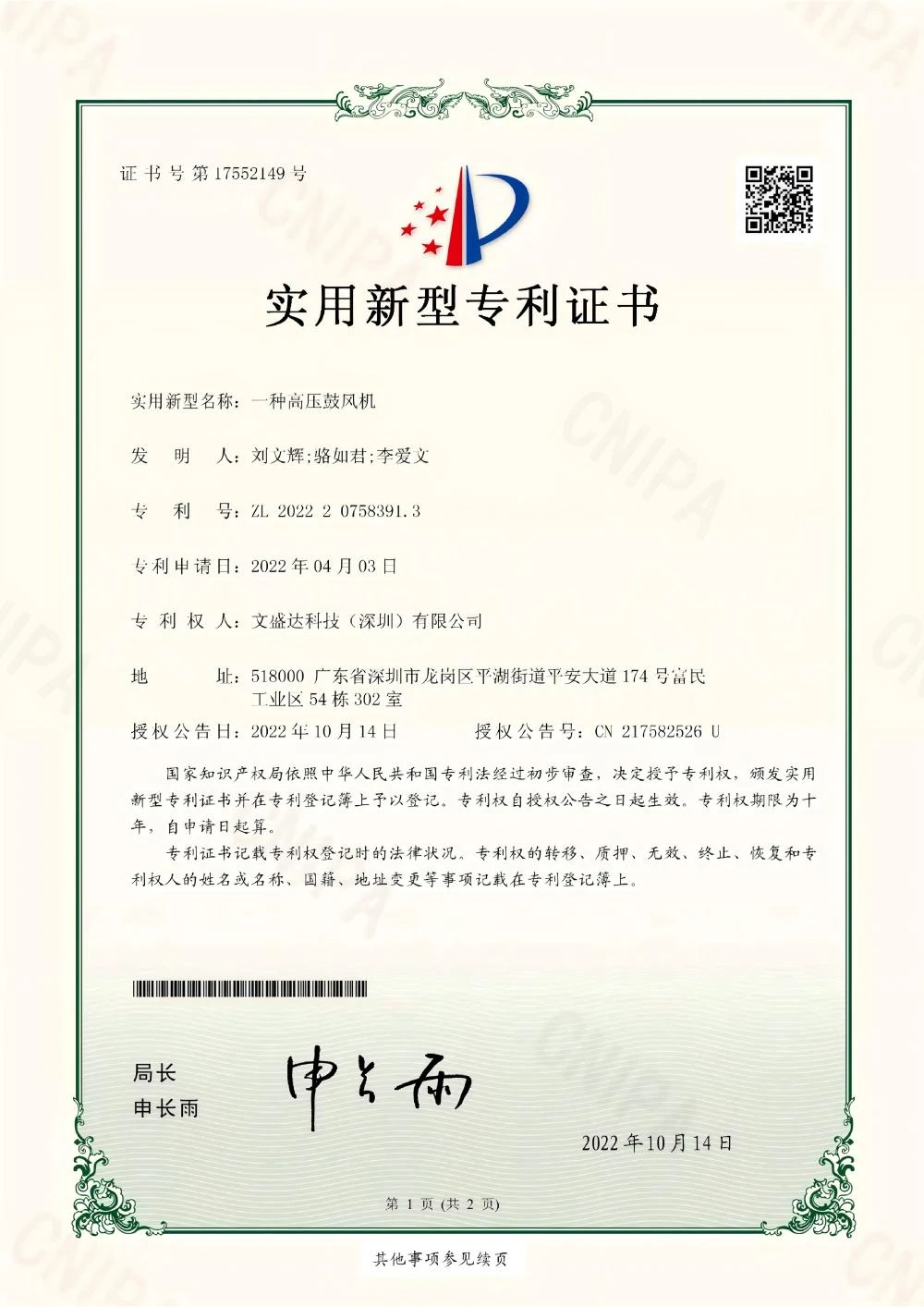
Utility Model Patent Certificate

Design Patent Certificate
Hot Tags: brushless fan, China brushless fan manufacturers, factory, brushless blower motor, Brushless Frequency Converter Blower, Brushless Speed regulating Blower, winsinn 50mm blower fan, brushless centrifugal fan, fan brushless
Previous
No InformationYou Might Also Like


Send Inquiry